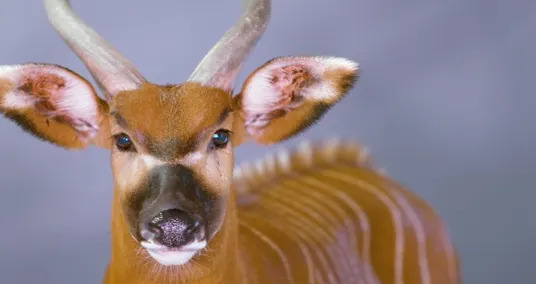
Deep within the forests of Kenya lives one of the most striking yet elusive antelopes in the world, the eastern bongo. Recognised for its rich chestnut coat marked with bold white stripes, this animal stands out as one of Africa’s most visually unique species. Despite its large size, the eastern bongo remains shy and rarely seen in the wild. It inhabits only a few isolated mountainous forest regions in Kenya, making its presence both special and fragile. Adult bongos can weigh between five hundred and nine hundred pounds, with long spiralling horns that can reach up to forty inches. These horns are not only impressive in length but also proportionally wide, matching the animal’s body size. As herbivores, bongos feed on leaves, shrubs, and forest vegetation, relying on dense cover for protection. They are most active during twilight and dusk, when low light helps them avoid predators. This behaviour, combined with their cautious nature, makes them difficult to observe even for experienced wildlife researchers. Their environment plays a crucial role in their survival, as the forests provide both food and shelter. However, this delicate balance is now under serious threat, placing the eastern bongo among the most endangered animals in Africa today.
The eastern bongo’s population has declined dramatically over time, with estimates suggesting that only around one hundred individuals remain in the wild. This number places the species well below the threshold for critical endangerment and highlights the urgency of conservation efforts. The primary threats facing these animals include illegal hunting and the destruction of their forest habitats. As forests are cleared for agriculture and human settlement, the safe spaces that bongos rely on continue to shrink. In response to this crisis, conservation organisations and local authorities in Kenya have taken important steps to protect the species. Certain forest regions have been designated as protected areas, allowing bongos to move freely without the constant threat of poaching. These efforts aim to stabilise and eventually increase the population, though recovery remains a long term challenge. Protecting the eastern bongo is not only about saving a single species, it is also about preserving the biodiversity of Kenya’s unique ecosystems. Each animal plays a role in maintaining ecological balance, and the loss of one can have wider consequences. The story of the eastern bongo serves as a powerful reminder of the impact human activity can have on wildlife and the importance of continued conservation action.
LATEST POSTS
- 1
 Poll: 62% of Americans would oppose U.S. military action in Greenland
- 2Alice Wong, founder of the Disability Visibility Project, dies at 51
- 3Bennu asteroid samples provide clues about solar system origins and 'space gum'
- 4These are the Fastest Italian Sports Cars
- 5ABC News' Sam Champion opens up about recent health scare



- When will the Epstein files be released — and will they reveal anything new?
- She loves to give experiences. He goes for sentimental gifts. They ask an expert: What is the perfect holiday present?
- Cognizant Couture d: A Survey of \Moral Decisions and Sharp Looks\ Maintainable Style
- Famous Versatile Brands: Your Decision
- FDA adds strongest warning to Sarepta gene therapy linked to 2 patient deaths
- Doctors looking into hormone therapy as a way to ward off dementia in women
- Midlife weight gain can start long before menopause – but you can take steps early on to help your body weather the hormonal shift
- Israel's ban on unsupervised reporters in Gaza causes strategic harm to legitimacy
- Internet goes (cocoa) nuts: The funniest reactions to 12 tonne theft of KitKat bars